
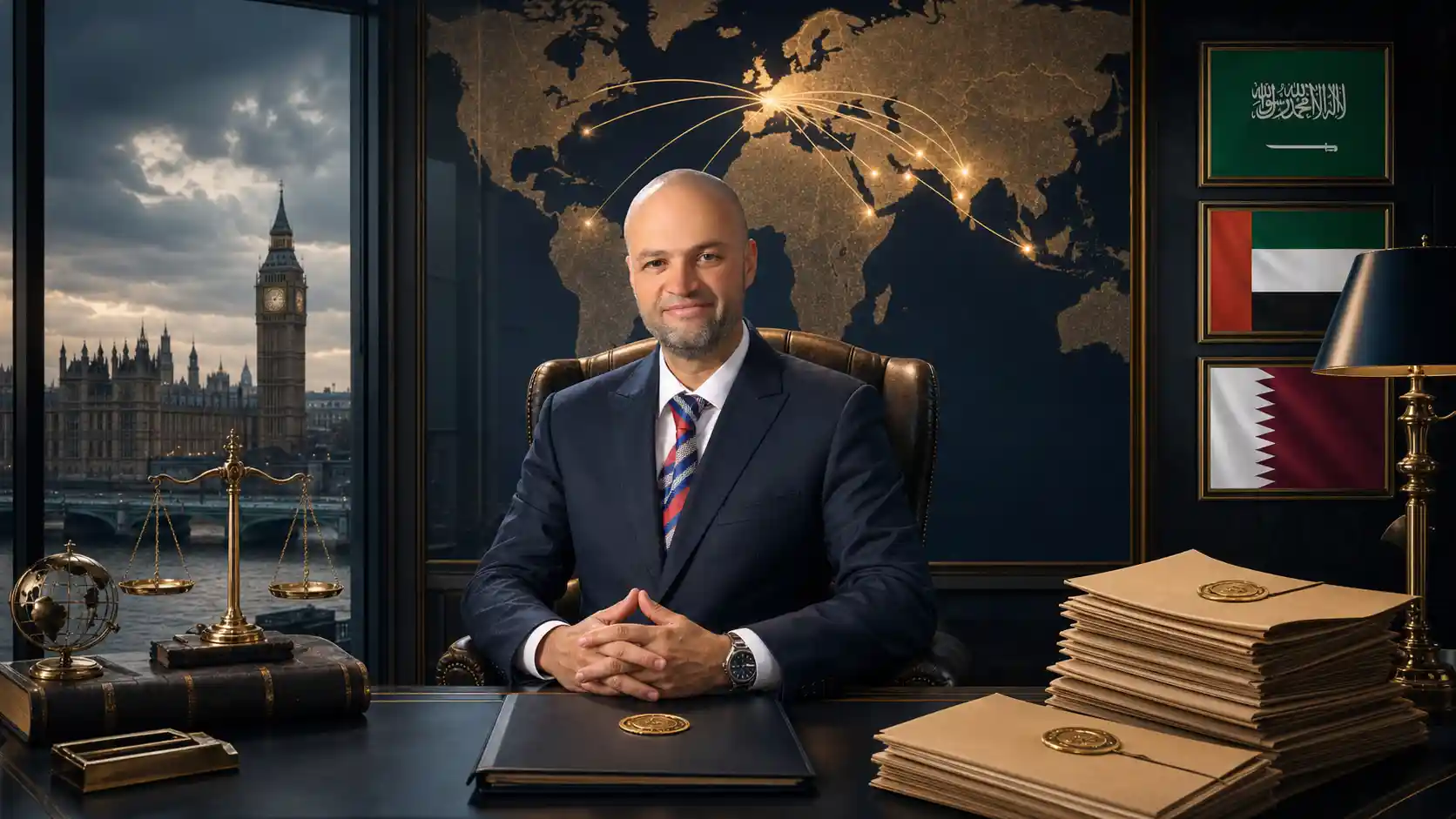
Three men from three different countries, none of them knowing each other. One is Saudi from Jeddah, the second is Emirati from Dubai, and the third is Qatari from Doha. Thousands of kilometers separate them, but they are united by the details of one story: they fell victim to fraudulent trading companies, sought to recover their losses, and found closed doors everywhere—until they reached the office of lawyer Farhan Al-Khaled Law Firm in London.
In this article, we document three true stories from the firm’s files (using pseudonyms to protect client privacy). Each story reveals a different pattern of financial fraud and explains how the legal team dealt with them.
The first story: The Saudi and the “Islamic” platform — $215,000
trap
“Abu Faisal,” a Saudi petroleum engineer from Jeddah, was contacted by an account manager who claimed that his platform was “compliant with Islamic law” and did not use prohibited leverage. He sent him a “Sharia endorsement” certificate from a well-known sheikh (later found to be forged).
He deposited $50,000, then gradually increased over 4 months until he reached $215,000 after reinvesting the “profits”.
The terrifying moment
He requested a withdrawal to perform Umrah, but was asked to pay 8% “Zakat on profits” upfront. Sensing something was wrong, he refused. The platform disappeared after 72 hours.
The solution is through Farhan Al-Khaled’s office.
Lawyer Farhan Al-Khaled explains what distinguishes this type of fraud: “Exploiting the religious aspect is one of the most insidious methods of fraud in the Gulf. Fraudsters target a segment of religious people who find it difficult to realize that someone using religious language may be a fraudster. These cases require special psychological and legal handling.”

The office team worked on three fronts:
- Documenting the legal forgery through an investigation with the sheikh mentioned in the testimony (who denied his connection to the platform in writing)
- Tracking transfers that passed through an Estonian bank and then to a cryptocurrency wallet
- A complaint to the alleged licensing authority revealed that the entire “license” was forged.
Result
Abu Faisal recovered $172,000 after six months of legal action. He commented, “More important than the money that was returned is that I understood that fraud knows no religion or nationality.”
The second story: Emirati and crypto “golden opportunities” — $95,000
trap
“Umm Muhammad,” an Emirati businesswoman from Dubai, participated in a VIP Telegram group for trading digital currencies that was professionally supervised by a “financial analyst” and had a seemingly verified LinkedIn account.
The “analyst” was providing successful daily recommendations (it later turned out that she was sharing them after they had already happened in the market, i.e., after it was too late to verify).
An “exclusive investment opportunity” was offered in a new currency before its official launch — Umm Muhammad deposited $95,000.
The terrifying moment
The new currency was never launched. The Telegram account was deleted. The LinkedIn account disappeared. When I tried to trace the transfer, I discovered it went to a USDT wallet on the Tron network.
The solution is through Farhan Al-Khaled’s office.
Lawyer Farhan Al-Khaled says about cryptocurrency cases: “Blockchain is a double-edged sword — it sometimes makes tracking difficult, but it also permanently records every transaction. Our technical team used advanced blockchain analysis tools to track the wallet across 11 intermediate transactions.”
The team used:
◀ Forensic blockchain analysis through specialized partners in London
◀ Direct contact with Binance to freeze the final wallet
Identifying the fraudster by linking the wallet to a KYC account on a secondary exchange
Result
Umm Muhammad recovered $68,000 (71% of the amount). The rest is still being tracked. She commented: “The most important lesson I learned: Anyone who claims to be able to predict the market is a fraud. The market is unpredictable.”
The third story: The Qatari and the forged arbitration contract — $1.2 million
trap
“Abu Hamad,” a Qatari businessman from Doha, invested in a company claiming to be a hedge fund licensed in the Cayman Islands. The initial deposit was $1.2 million.
The contract included an arbitration clause at the DIFC in Dubai to give it legal credibility. The website was very professional, and there was a physical office in a prominent tower in Zurich.
The terrifying moment
After 11 months of gradual additional deposits (totaling $1.2 million), he applied for a partial withdrawal. The response was surprising: “Your contract stipulates a 5-year lock-up period; any withdrawal before that is subject to a 78% penalty.”
He went back to the contract and found a small clause written in much smaller print than the rest of the clauses.
The solution is through Farhan Al-Khaled’s office.
Lawyer Farhan Al-Khaled explains this type of case: “This is not an ordinary fraud case, but a case of a fraudulent contract . The challenge is not just to recover the money, but to prove that the entire contract is invalid because it is based on misleading information.”
The team moved along several axes:
- License verification in the Cayman Islands — it turned out to have expired 3 years ago
- Checking the office in Zurich — it turned out to be a “virtual office” with no employees.
- A lawsuit was filed in the DIFC (Dubai International Disputes Court) to challenge the validity of the contract on the grounds of fraud.
- The company’s assets in Swiss banks were frozen by court order.
Result
After 14 months of multi-pronged action, Abu Hamad recovered $940,000 (78.3% of the amount). A final judgment was issued against the company, and additional assets were frozen pending enforcement.
Abu Hamad commented in a thank-you letter to the office: “I thought the money was lost forever, especially after I read the contract myself. What I didn’t realize is that a contract based on fraud becomes legally worthless. This is what the team of lawyer Farhan Al-Khaled taught me.”
What do the three stories have in common?
Despite the differences in the details of each story, the law firm of Farhan Al-Khaled discovered common patterns in financial fraud companies targeting the Gulf:
Pattern 1: Exploiting cultural trust
Whether it’s religious (Story 1), through a “successful analyst” (Story 2), or with fake official documents (Story 3) — every scam begins with elaborate trust engineering .
Pattern 2: Tiered Deposits
No one loses a million dollars all at once. The trap always starts with a small deposit and a successful withdrawal, then it gradually increases.
Pattern 3: The financial pretext for booking
When a withdrawal request is made, a new pretext always appears: tax, verification fees, lock-up period, penalty… The goal is to extract more money from the victim, not just prevent him from withdrawing.
Why did Farhan Al-Khaled’s office succeed where others failed?
From analyzing the three stories, we can deduce three key factors for success:
1. Location in London
The fact that Farhan Al-Khaled’s office is located in London opens doors that no local office can open:
◀ Direct access to the UK FCA
◀ Cooperation with Action Fraud
◀ Legal influence in the Commonwealth
◀ An effective European judicial network
2. Combining law and technology
The firm’s team is not limited to lawyers, but also includes:
◀ Blockchain Forensics Analysts
◀ Experts in tracking money across borders
◀ Digital fraud specialists
◀ International financial advisors
3. Speed and transparency
In all three cases, the speed of response was a crucial factor. The initial assessment of the case takes place within 48 hours, and transparency in presenting the possibilities (including negative ones) builds the client’s confidence from day one.
A message to the Gulf reader
Each of these stories began with “This won’t happen to me.” The harsh reality is that digital financial fraud in 2026 is more sophisticated than ever, and its victims are not only ordinary people, but also seasoned businesspeople and educated investors.
As lawyer Farhan Al-Khaled says at the end of every consultation: “The best person to fight a battle and win is the one who avoids the battle altogether. But if you fall into the trap, don’t fight the battle alone.”
Frequently Asked Questions (FAQ)
Q1: How do I know if my story is legally resolvable?
Through a free initial assessment from Farhan Al-Khaled’s office. The team determines the likelihood of recovery within 48 hours based on the type of fraud, the age of the case, and the quality of the available evidence.
Q2: Do I need to be in London to deal with the office?
No. The firm deals with clients from all Gulf countries via virtual meetings, and has local legal partnerships in most Gulf capitals.
Q3: What is the average recovery rate in forex cases?
It ranges between 60% and 85% in well-documented cases. The percentage decreases as the case lasts longer or the evidence weakens.
Q4: How long does a money refund case take?
The average processing time is between 4 and 14 months, depending on complexity. Simple cases via chargeback may be resolved in weeks.
Related Reading: Why Website Hosting Cost Matters for Your UAE Business Strategy

