
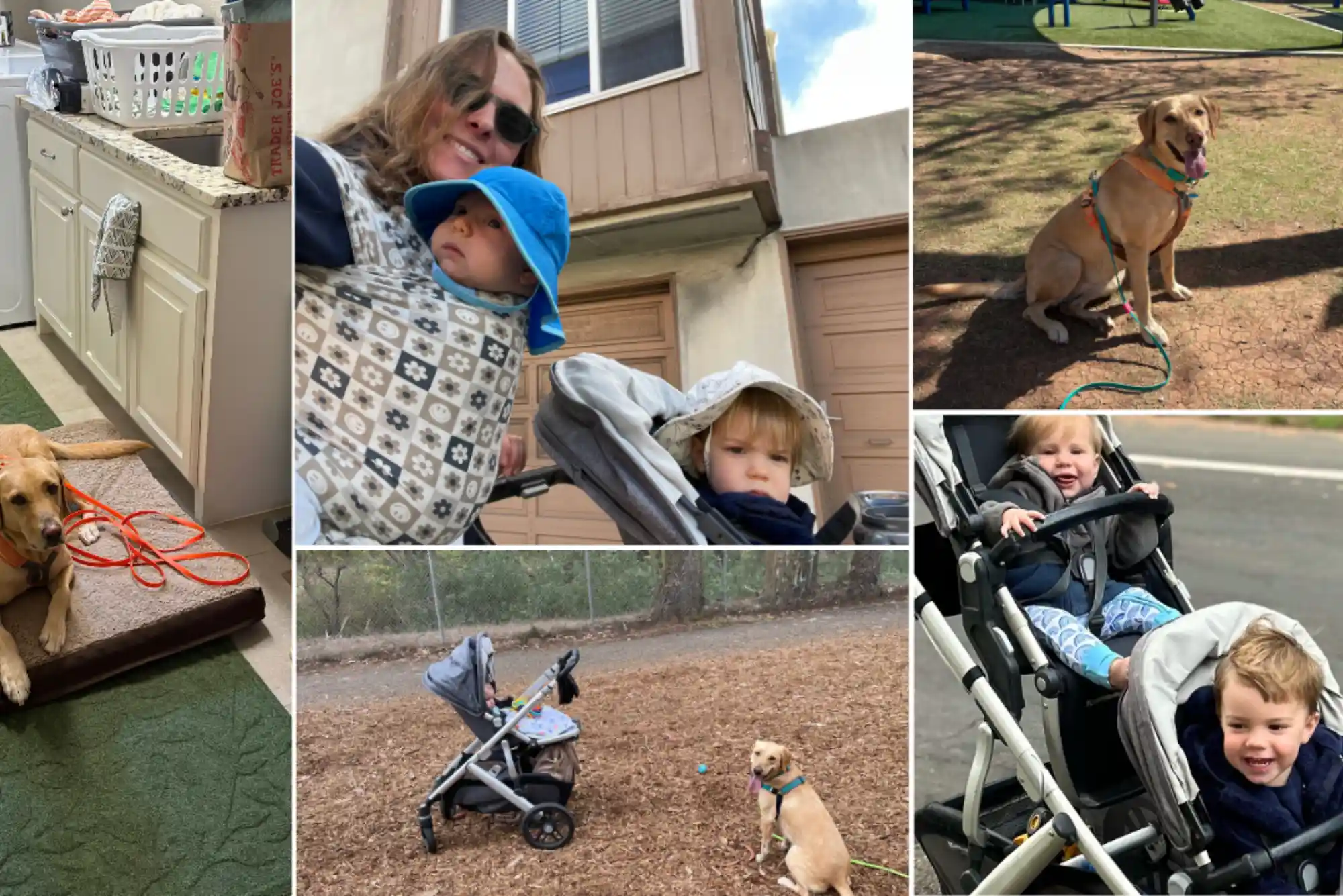
Introudction
Taking your dog for a walk while pushing a stroller can be enjoyable, but it can also become stressful when your dog pulls, crosses in front of the stroller, or lunges at people, dogs, bikes, and other distractions. Learning how to train a dog to walk beside a stroller is therefore about more than teaching basic leash manners. Your dog needs to understand how to move calmly beside a moving object while staying aware of you.
The good news is that most dogs can learn this skill with gradual practice and positive reinforcement. Loose-leash walking is a trained behavior rather than something dogs automatically understand. The American Kennel Club recommends rewarding dogs for walking on a slack leash and stopping when they pull rather than allowing pulling to move them forward.
When a stroller is involved, safety becomes even more important. A dog that suddenly lunges can potentially pull the handler off balance or cause the stroller to veer unexpectedly. The goal is not perfect competition-style heeling. Instead, you want a relaxed dog who can walk near the stroller, respond to simple cues, and remain calm when distractions appear.
Why Training a Dog to Walk Beside a Stroller Is Different
A stroller changes the walking environment. It is larger than your body, has wheels, makes sounds, and moves differently from you. Some dogs may be curious about it, while others may become excited or nervous.
Your dog may also have less room to move freely because you are managing both the leash and stroller. That makes uncontrolled pulling particularly inconvenient.
Dogs pull for many reasons. They may want to investigate a smell, greet another dog, chase something moving, or simply reach an interesting destination faster. Pulling can become stronger when the dog learns that pulling successfully gets them closer to whatever they want. Consistent reinforcement is therefore essential.

Lunging is slightly different. A dog may lunge because of excitement, frustration, fear, or over-arousal. Leash reactivity can involve barking, pulling, lunging, or intense fixation on a trigger.
Before adding a stroller, teach your dog the basic walking skills separately.
Start With Loose-Leash Walking Without the Stroller
The foundation for learning how to train a dog to walk beside a stroller is reliable loose-leash walking.
Choose a quiet area where your dog can concentrate. Let your dog walk beside you on whichever side will be most practical when you eventually use the stroller. Keep the leash loose and reward your dog whenever they remain near you without tension.
You do not need your dog glued to your leg. A comfortable walking position with enough space between the dog and stroller is usually safer and more realistic.
If your dog moves ahead and tightens the leash, stop. Avoid pulling backward on the leash because this can create a tug-of-war and may encourage the dog to pull against the pressure. Instead, wait for the leash to become loose or encourage your dog back toward you. Then reward and continue walking. This stop-and-resume approach teaches that a loose leash makes forward movement possible.
Practice this until your dog can walk calmly for several minutes before introducing the stroller.
Teach a Reliable “With Me” Cue
A simple verbal cue can make stroller walks much easier.
Choose a phrase such as “with me,” “let’s go,” or another cue that your household will use consistently. Say it in a calm, upbeat voice while your dog is already near you, then reward the dog for moving with you.
The cue should not mean “never sniff” or “never explore.” It simply tells your dog that you want them to stay connected to your movement.
You can also teach a “leave it” or attention cue separately. These skills become valuable when a squirrel, cyclist, child, or another dog suddenly attracts your pet’s attention.
The American Kennel Club notes that clear walking cues and direction-changing cues can help dogs understand that they should follow their handler rather than simply move wherever they want.
Introduce the Stroller While It Is Stationary
Do not begin by pushing the stroller down a busy sidewalk with your dog attached to you. First, let your dog become comfortable with the stroller while it is stationary.
Place the stroller in a familiar area. Allow your dog to observe it from a comfortable distance. Reward calm behavior, such as looking at the stroller and then looking back at you.
There is no need to force your dog to approach it.
If your dog is nervous, increase the distance. If your dog becomes extremely excited, wait for calmer behavior before continuing. The goal is to make the stroller a predictable part of the environment rather than something that automatically triggers excitement.
This is an example of gradual desensitization and counterconditioning. These techniques involve exposing a dog to a trigger at an intensity they can handle while pairing the experience with something positive. Veterinary behavior guidance recommends keeping dogs below their stress threshold and increasing difficulty gradually.
Practice Walking Beside an Empty Stroller
Once your dog is comfortable around the stationary stroller, begin moving it slowly.
Have another adult push the stroller while you focus entirely on the dog, if possible. This is safer and makes it easier to reward the behavior you want.
Start with only a few steps. If your dog stays beside you with a loose leash, reward immediately. Stop before your dog becomes overly excited.
Then repeat.
Gradually increase the distance you walk while maintaining calm behavior. If your dog starts pulling toward the wheels, stop and wait for the leash to loosen. If your dog tries to cross in front of the stroller, calmly guide them back to their designated walking area and reward the correct position.
Do not expect a long neighborhood walk on the first attempt.
Short successful sessions are far more useful than one exhausting session in which your dog repeatedly practices pulling.
Keep a Safe Distance From the Stroller
One of the most important parts of learning how to train a dog to walk beside a stroller is teaching spatial awareness.
Your dog should not walk directly underneath the stroller or immediately in front of its wheels. Choose a consistent position beside you that gives the stroller plenty of clearance.
A slightly wider walking position can be safer than trying to keep your dog extremely close to the stroller.
Watch your leash length as well. A leash that passes across the front of the stroller can create a dangerous situation if your dog suddenly changes direction.
During training, pay attention to your own movement too. Smooth turns and predictable walking make it easier for your dog to understand what you expect.
Teach Your Dog That Pulling Stops the Walk
If your dog pulls toward something while walking beside the stroller, do not allow the pulling to become a successful strategy.
Stop the stroller safely before addressing the dog. Once the leash becomes loose and your dog reconnects with you, reward the calm behavior and continue.
This principle is simple: pulling does not produce forward movement, while calm walking does.
The same approach should be used by everyone who walks the dog. Inconsistent rules can slow training because the dog may learn that pulling sometimes works and sometimes does not. Consistency among family members and dog walkers is an important part of maintaining leash manners.
Manage Lunging Before It Happens
Lunging is more serious than ordinary pulling because the dog may suddenly accelerate toward a trigger.
Do not wait until your dog is already barking and lunging before deciding what to do. Learn to recognize the early signs of rising arousal. Your dog may stare intensely, stiffen their body, speed up, stop responding to you, or become fixated on another dog or moving object.
At that point, create more distance.
For example, if another dog is approaching and your dog is beginning to stare, move away from the path before the reaction becomes intense. You might cross the street, turn around, or step into a quiet area.
Veterinary behavior guidance recommends increasing distance from triggers and working gradually rather than repeatedly exposing a dog to situations that cause intense reactions.
This is especially important when a stroller is present because you need enough room to manage both the dog and stroller safely.
Pair Stroller Walks With High-Value Rewards
Regular dry food may be enough for some dogs, but difficult situations often require something more motivating.
Use tiny pieces of a treat your dog genuinely enjoys. Reward your dog for behaviors such as walking beside you, looking at you, responding to “with me,” slowing down, and calmly passing distractions.
You do not have to give treats every few seconds forever. Frequent reinforcement is useful while teaching the skill. Once your dog understands the behavior, you can gradually reduce the frequency and use other rewards, such as praise, continued walking, or an opportunity to sniff.
Sniffing can itself be rewarding and can provide valuable mental stimulation during walks.
Choose Equipment That Gives You Control
Equipment does not replace training, but appropriate equipment can make training safer.
A properly fitted harness can be useful for dogs that pull, particularly when you are working on loose-leash skills. A front-clip harness may provide additional control for some dogs.
The key is proper fit and safe handling. Your dog should not be able to slip out of the equipment, and the leash should be strong enough for the dog’s size and behavior.
Avoid relying on harsh leash corrections. Punishing a dog while they are reacting can potentially increase fear or frustration, especially when the behavior is driven by emotional reactivity. Positive reinforcement and controlled exposure are generally better foundations for changing the underlying response.
If your dog is powerful enough that you cannot physically control them safely around a stroller, stop practicing in public and seek professional assistance.
Gradually Add Real-World Distractions
Once your dog can calmly walk beside an empty stroller in a quiet area, increase the difficulty slowly.
Try a quiet sidewalk before a busy park. Introduce mild distractions before highly exciting ones. Practice passing stationary objects before dealing with fast-moving bicycles or crowded paths.
Your dog should succeed at the current difficulty level before you make the environment harder.
If your dog repeatedly pulls or lunges, the training environment is probably too difficult. Move farther away from distractions and return to an easier stage.
Desensitization works best when the dog remains comfortable. Continuing exposure after a dog becomes highly stressed can make future reactions stronger rather than better.
Common Mistakes to Avoid
One common mistake is trying to train during a full-length family walk. A busy walk contains too many variables for a dog that is still learning.
Another mistake is moving the stroller too quickly. The stroller should initially be introduced as slowly and predictably as possible.
Some owners also focus entirely on correcting pulling instead of rewarding good behavior. Dogs learn more clearly when they understand what behavior earns reinforcement.
Avoid waiting for perfection. If your dog walks calmly for five steps beside the stroller, those five steps are training opportunities worth rewarding.
Most importantly, do not punish lunging with harsh corrections. If your dog is reacting emotionally to a trigger, punishment may change the outward behavior without addressing the underlying emotion. Instead, prioritize distance, safety, and gradual behavior modification.
How Long Does Stroller Walking Training Take?
There is no universal timeline.
A dog with good leash skills may adjust to stroller walking relatively quickly. A dog that has practiced pulling for years or reacts strongly to dogs, people, bicycles, or unusual objects may need considerably longer.
Progress should be measured by behavior rather than by the calendar.
Perhaps your dog previously pulled for the entire walk but now walks calmly for several minutes. That is meaningful progress. If your dog can pass a mild distraction without lunging, that is another important step.
Short, frequent sessions usually make more sense than forcing your dog through long sessions when they are already tired or overstimulated.
If your dog is becoming increasingly reactive, cannot safely be controlled, or has attempted to bite, consult your veterinarian and consider working with a qualified reward-based trainer or veterinary behavior professional.
What a Successful Stroller Walk Looks Like
A successful stroller walk does not require your dog to stare at you constantly.
Your dog should be able to walk at a comfortable pace, keep the leash reasonably loose, respond when you change direction, and remain safely away from the stroller wheels. They should also be able to notice normal distractions without immediately pulling or lunging.
There will still be moments when your dog wants to sniff or investigate something. That is normal.
The goal is cooperation rather than robotic obedience.
When your dog understands that calm behavior allows the walk to continue, stroller walks become much more predictable. You can focus on your surroundings and your child instead of constantly fighting the leash.
Make Stroller Walks Calm and Predictable
Learning how to train a dog to walk beside a stroller takes patience, careful management, and plenty of reinforcement. Start by teaching loose-leash walking without the stroller, then introduce the stroller while it is stationary. Progress to slow movement, reward calm behavior, maintain a safe distance from the wheels, and gradually introduce real-world distractions.
If your dog pulls, stop and wait for a loose leash before continuing. If your dog begins to lunge, increase distance rather than forcing them closer to the trigger. Most importantly, keep training sessions short enough that your dog can succeed.
With consistent practice, the stroller can become just another normal part of your dog’s walking routine.
FAQs
How do I stop my dog from pulling on the leash?
Stop moving whenever the leash becomes tight and wait for your dog to return toward you or create slack. Reward the loose leash, then continue walking. This teaches the dog that pulling does not make the walk move forward.
How do I train my dog to walk beside me?
Begin in a quiet environment and reward your dog for staying near your chosen walking position. Introduce a cue such as “with me” and gradually practice around distractions. Loose-leash walking should be taught before expecting the dog to handle a challenging environment such as a stroller walk.
How long does it take to train a dog not to pull?
The timeline depends on the dog’s age, temperament, previous experience, and consistency of training. Some dogs improve quickly, while established pulling habits or reactivity can require weeks or months of structured practice.
Why does my dog lunge at other dogs while walking?
Lunging can be caused by excitement, frustration, fear, anxiety, or other forms of reactivity. A dog that lunges may be too emotionally aroused to respond normally to cues. Creating distance and gradually changing the dog’s response to the trigger can be more effective than simply correcting the behavior.
What is the best leash for a dog that pulls?
There is no single leash that works for every dog. A sturdy, appropriately fitted harness can provide useful control while you teach loose-leash walking. For strong or reactive dogs, equipment should be selected with safety and professional guidance in mind rather than treated as a replacement for training.
Can an older dog learn to stop pulling?
Yes. Older dogs can learn new walking habits. The process may take longer if pulling has been reinforced for years, but reward-based training, consistency, and gradual exposure can still produce meaningful improvement.
Should I punish my dog for lunging?
Harsh punishment is generally not recommended for leash reactivity. If lunging is connected to fear or frustration, punishment can make the emotional response worse. Focus on preventing overwhelming situations, increasing distance, rewarding calm behavior, and getting professional help when necessary.
How can I safely walk my dog and push a stroller at the same time?
First teach your dog reliable loose-leash walking without the stroller. Then introduce the stroller gradually and practice in quiet locations. Keep your dog away from the wheels, avoid allowing the leash to cross the stroller, and use another adult to push the stroller during early training sessions whenever possible.

